What Does an Air Compressor Do? A Plain Explanation
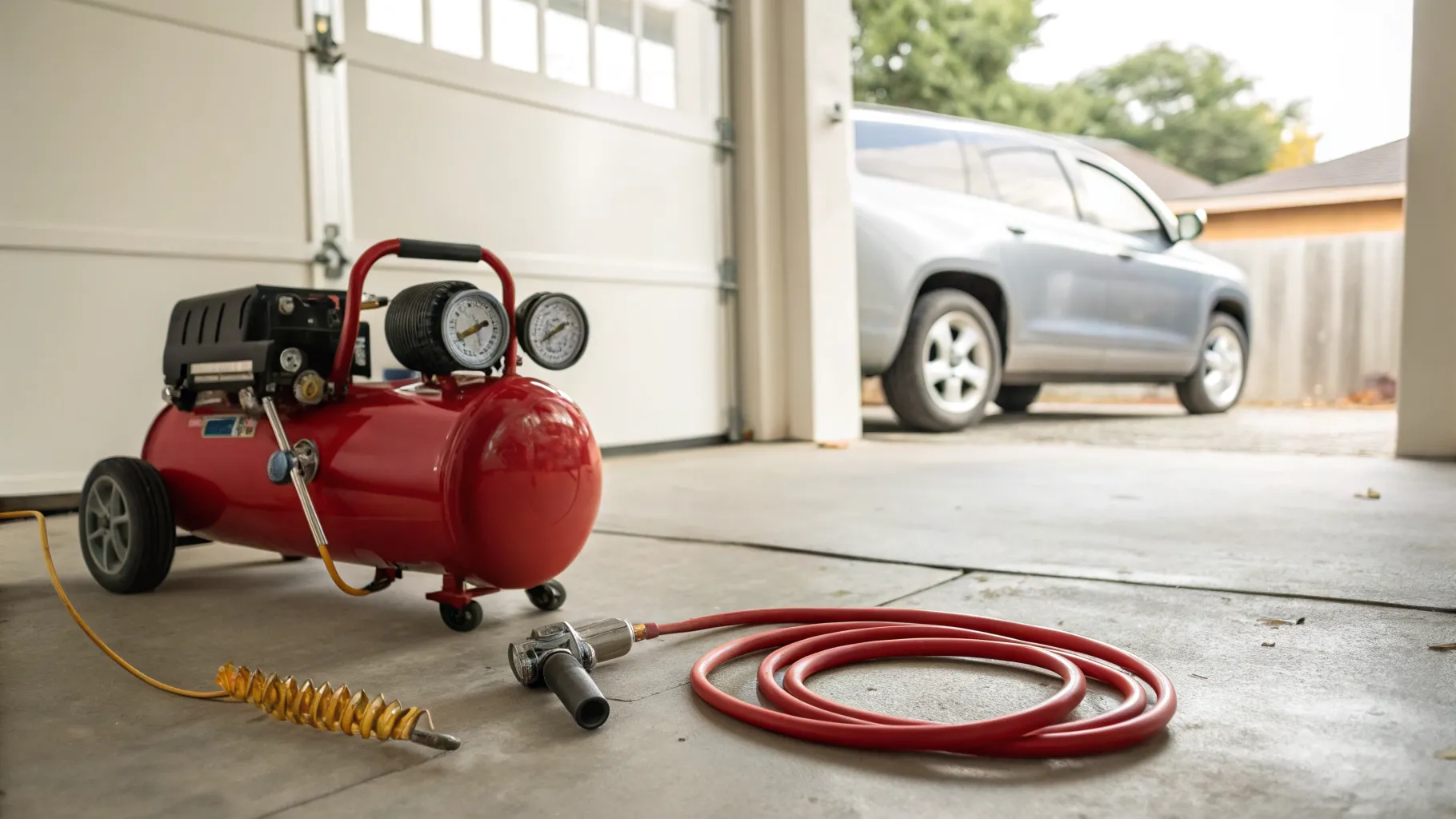
An air compressor takes power from an electric motor or a gas engine and turns it into stored energy in the form of pressurized air. It pulls in ordinary air from the room, squeezes it into a smaller space so the pressure rises, and holds it in a tank until you release it to do work: driving a nail, spinning an impact wrench, filling a tire, atomizing paint. The machine itself does not nail, spin or spray anything. It manufactures the pressurized air, and the air does the work.
That is the whole job. The US Department of Energy’s compressed air sourcebook notes that compressed air is often considered the “fourth utility” alongside electricity, water and gas, because in many industrial plants the air compressors use more electricity than any other type of equipment. Systems range from 5 horsepower garage units to industrial installations beyond 50,000 horsepower, but the principle is identical at every size: convert motor power into air pressure, store it, spend it.
This page explains how that happens step by step, what the gauges and specs actually mean, and how the answer should shape your decision if you are thinking about buying one.
How an air compressor works, step by step
Nearly every compressor you would put in a home garage is a positive displacement machine, usually a reciprocating piston design. The sequence runs like this:
- Intake. The motor drives a piston down inside a cylinder, pulling ambient air in through an intake valve, past a filter.
- Compression. The piston drives back up, shrinking the space the air occupies. Less volume, same amount of air, so the pressure climbs.
- Storage. The pressurized air is pushed through a one-way valve into the tank, where it sits as potential energy.
- Cut-out. A pressure switch monitors the tank. When it reaches the cut-out pressure (often around 125 to 135 PSI on a single-stage unit), the motor shuts off.
- Use. You open the line by pulling a tool trigger. Air leaves the tank, through a regulator, down the hose, into the tool.
- Cut-in. As the tank empties, pressure falls. At the cut-in pressure the switch starts the motor again and the cycle repeats.
That cut-in and cut-out cycle is why your compressor kicks on and off while you work. It is normal. It is also why there are two gauges on the front: one shows the pressure inside the tank, the other shows the regulated pressure being sent to your tool. You set the second one with the regulator knob, usually to 90 PSI, because that is the pressure most air tools are designed to run at. If your unit cycles at the wrong pressures, see how to adjust an air compressor pressure switch.
The two families of compressor
- Positive displacement compressors physically shrink a chamber full of air. Reciprocating pistons, rotary screws and rotary vanes all work this way. Everything sold for home, garage and small shop use is in this family, almost always a piston.
- Dynamic (centrifugal) compressors use spinning impellers to accelerate air and convert that speed into pressure. These are large industrial machines; you will not meet one at the hardware store.
Single-stage vs two-stage
A single-stage piston compresses the air once. A two-stage unit compresses it, cools it in an intercooler, then compresses it again in a second smaller cylinder. The practical differences:
| Single-stage | Two-stage | |
|---|---|---|
| Maximum pressure | About 120 to 135 PSI | About 175 PSI |
| Efficiency | Baseline | Roughly 15 to 20% more CFM per horsepower |
| Typical buyer | DIY, trim work, tires, most garages | Busy shops, continuous air tool use |
For most homeowners the single-stage is the right call; the two-stage premium pays off when tools run all day. Buyers on machinist forums ask whether two-stage matters at similar SCFM, and the honest answer is: at the same delivered airflow, the two-stage earns its keep through higher pressure ceiling, cooler running and efficiency under sustained load, not through anything a weekend user would feel.
PSI, CFM and SCFM: what the numbers mean
The spec sheet is where “what does it do” turns into “what can it do for me.” Three numbers matter:
- PSI (pounds per square inch) is pressure, the force behind the air.
- CFM (cubic feet per minute) is volume, how much air flows.
- SCFM is CFM normalized to standard conditions (68 degrees F, 14.7 PSI atmospheric pressure, 36% relative humidity), which makes it the fairest number for comparing brands.
A tool needs both satisfied at the same time. Plenty of pressure with too little flow means the tool spins up, stalls, and waits for the pump to catch up. The numbers that follow are typical consumption at 90 PSI:
| Tool | Air used at 90 PSI |
|---|---|
| Brad nailer | 0.5 to 1 CFM |
| Framing nailer | About 2.2 CFM |
| 1/2-inch impact wrench | 4 to 5 CFM |
| 1-inch impact wrench | 10 to 15 CFM |
| Conventional spray gun | 10 to 18+ CFM |
The standard sizing rule is to buy a compressor that delivers at least 1.5 times the CFM of your hungriest tool. This is also why a 6-gallon pancake compressor fires nail guns happily but chokes on a die grinder: nailers use air in short bursts the tank can absorb, while grinders and sanders drink continuously and quickly outrun a small pump. Tank size is a buffer; pump CFM is your sustained capacity. The full math is in what size air compressor do I need.
What people actually use them for
The confirmed everyday uses: powering pneumatic tools (nailers, impact wrenches, sanders, grinders, paint sprayers, sandblasters, jackhammers), inflating tires and inflatables, and blowing dust and debris off work. Industry adds manufacturing lines, pipeline work and drilling. For a job-by-job breakdown with the airflow each one demands, see what is an air compressor used for.
One distinction worth getting right, because plenty of pages get it wrong: the compressor in your refrigerator or air conditioner is not an air compressor. It compresses refrigerant in a sealed loop as part of a cooling cycle. An air compressor compresses ordinary air for you to use as a power source. Same mechanical idea, completely different machine and purpose.
Is it worth it if you are not a mechanic?
Honestly, for many households the answer is “only if you will use air tools or inflate things often.” Topping off tires monthly does not justify a compressor; a steady diet of trim carpentry, automotive work or spray finishing does. If you are weighing it, how to choose an air compressor walks through the decision tool by tool.
Two safety rules that come with the machine
Never use full-pressure air for cleaning, and never aim it at skin. OSHA regulation 29 CFR 1910.242(b) states that compressed air shall not be used for cleaning except where reduced to less than 30 PSI, and then only with effective chip guarding and personal protective equipment. The under-30-PSI figure applies to the dead-end pressure at the nozzle. Blowing 90 PSI air at yourself or your clothes is a genuine injury risk, not a workplace technicality.
Drain the tank after every use, or at least daily. Compressing air concentrates the moisture that was in it, and that water condenses inside the tank. Manufacturers like Campbell Hausfeld tell you to open the drain valve after each session because an undrained tank rusts from the inside, and a rust-weakened pressure vessel is the one failure mode you really do not want. Forum threads are full of people asking whether this is overkill; it is not, it takes ten seconds.
Why compressed air costs more than you think
The Department of Energy’s Compressed Air Sourcebook puts the wire-to-work efficiency of typical compressed air systems at around 10 percent. Most of the electricity becomes heat, not useful work at the tool. Poorly maintained industrial systems leak 20 to 30 percent of their capacity, versus under 5 to 10 percent for well-kept ones, and the same sourcebook notes that an industrial rotary screw machine controlled by inlet modulation can still draw about 70 percent of full-load power even when delivering no air at all.
For a homeowner none of this is a dealbreaker; a garage compressor runs in short bursts and the electricity cost is small. But it explains the machine’s character. Compressed air is a convenient, safe, flexible way to deliver power to a tool, not an efficient one. You pay for that convenience in watts, which is one more reason to size the compressor to the tools you actually run rather than buying the biggest one on the shelf.
Frequently asked questions
What is the main purpose of an air compressor? To convert motor or engine power into pressurized air, store that air in a tank, and release it on demand to power tools, inflate tires, or blow debris. It is a portable, storable power source; the air does the work, the tool just directs it.
Why does an air compressor have a tank? The tank stores compressed air so the pump does not have to run constantly. It also buffers bursts of demand: a nail gun can fire repeatedly off stored air while the pump rests. A bigger tank means longer runs between motor cycles, but it does not raise sustained airflow; only pump CFM does that.
Why does my compressor keep turning on and off? The pressure switch starts the motor when tank pressure falls to the cut-in point and stops it at the cut-out point (often around 125 to 135 PSI on single-stage units). That cycling is normal operation, not a fault.
Do I really need to drain the tank after every use? Yes, or at minimum daily when in use. Compression concentrates moisture from the intake air and it condenses in the tank. Left there, it rusts the tank from the inside and weakens it. Opening the drain valve takes seconds.
Can I use my compressor to blow dust off myself or my workbench? Not at full pressure. OSHA 1910.242(b) limits compressed air used for cleaning to under 30 PSI at the nozzle, with chip guarding and eye protection. High-pressure air can drive debris into eyes and air into skin, so never point it at anyone.
Is the compressor in my fridge or AC the same thing? No. Those compress refrigerant inside a sealed cooling loop. An air compressor compresses ambient air for you to use as power. They share the word, not the job.
More from Air Compressor Mag
Best Portable Air Compressors: Picks by Job (2026)
Real portable air compressor picks by job, from tire inflation to framing, with the CFM at 90 PSI, tank size, and noise specs that actually decide it.
CFM Explained: How to Choose a High CFM Air Compressor for Your Tools
How to read CFM ratings and pick a high CFM air compressor: the 90 PSI standard, SCFM, a tool chart, and when you need 10, 20 or 50 CFM.
Best 30 Gallon Air Compressors for Workshops
The best 30 gallon air compressor picks for a home workshop, compared on CFM, max PSI, single-stage pumps and 120V wiring so you match the unit to your tools.